
Bamboo Lessons:
What I Didn't Expect to Learn From Bamboo

Dear Substack,
This note excuses me from regular attendance here. I've missed checking in because I returned from a trip and immediately faced piles of work. Some of it carried weight; some of it didn't. Some stirred emotion; some required nothing but mindless effort.
I needed to focus on stuff. What stuff, you may ask?
Well, for one, I’ve been digging,
digging,
digging ,
digging,
digging,
and
DIGGING up bamboo rhizomes
in my backyard.
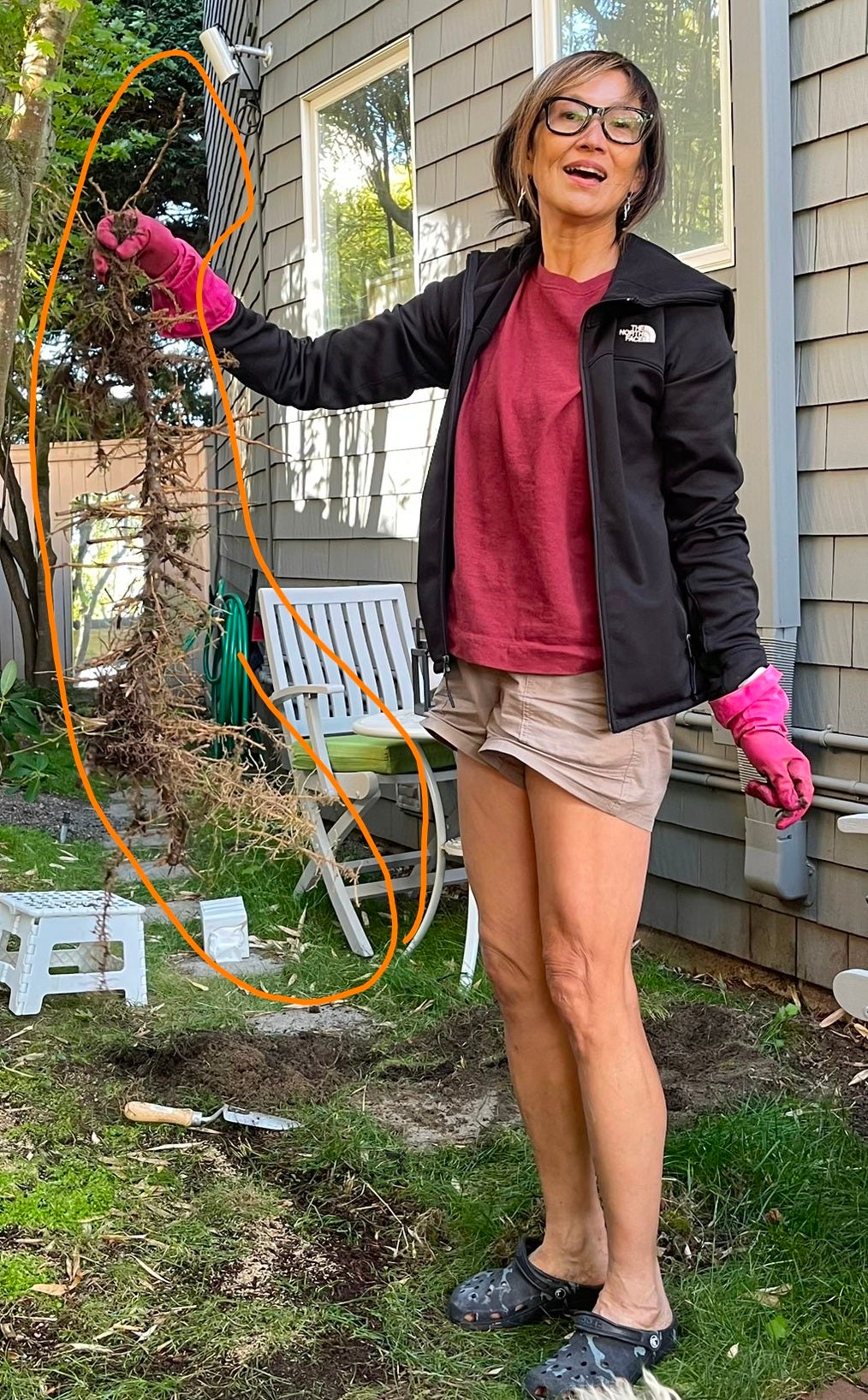
Last year, I planted grass with visions of my dog frolicking across it, never once investigating the subtle bumps already rising in the yard. With newfound motivation last week, I finally set out to level that failing patch, only to discover that bamboo roots, a.k.a. rhizomes, had pushed it up from below all along. As an inexperienced gardener, I had no idea these rhizomes would demand more than a few minutes of my time.
The more I dug, the more I realized how long these pesky and pernicious rhizomes were. My small project slowly invaded my mind. This was NOT supposed to take more than 15 - 30 minutes! WTF!!😡
“Just a little more digging, and surely this will end soon,” I convinced myself for hours.
Once an hour passed, I'd stop for a "break" and resume my work as an attorney. I'd brush the dirt off my hair, peel off my dirt-encrusted gloves, and log onto a Zoom call with an expert or a client.
Ah! This is more like it. Normal again.
Yet after I finished reviewing a deposition transcript, an odd pull drew me back to our tiny backyard.
Huh?
How?
That bamboo called to me, taunted me with eerie sing-songy whispers: “You’ll never get us!”
My gardening project taught me more than I expected. In my ignorance, I assumed I could yank a bamboo root out like a dandelion weed.
(Stop laughing. I can hear you. Yes, you’re right: I’m a gardening imbecile.)
This fight has shown me that bamboo outlasts nearly every plant I've encountered. Its strength lives in an invisible root system, the rhizomes, which stay slim (the thickest barely rivals a hot dog) but grow so tightly interwoven that they resist almost any force.
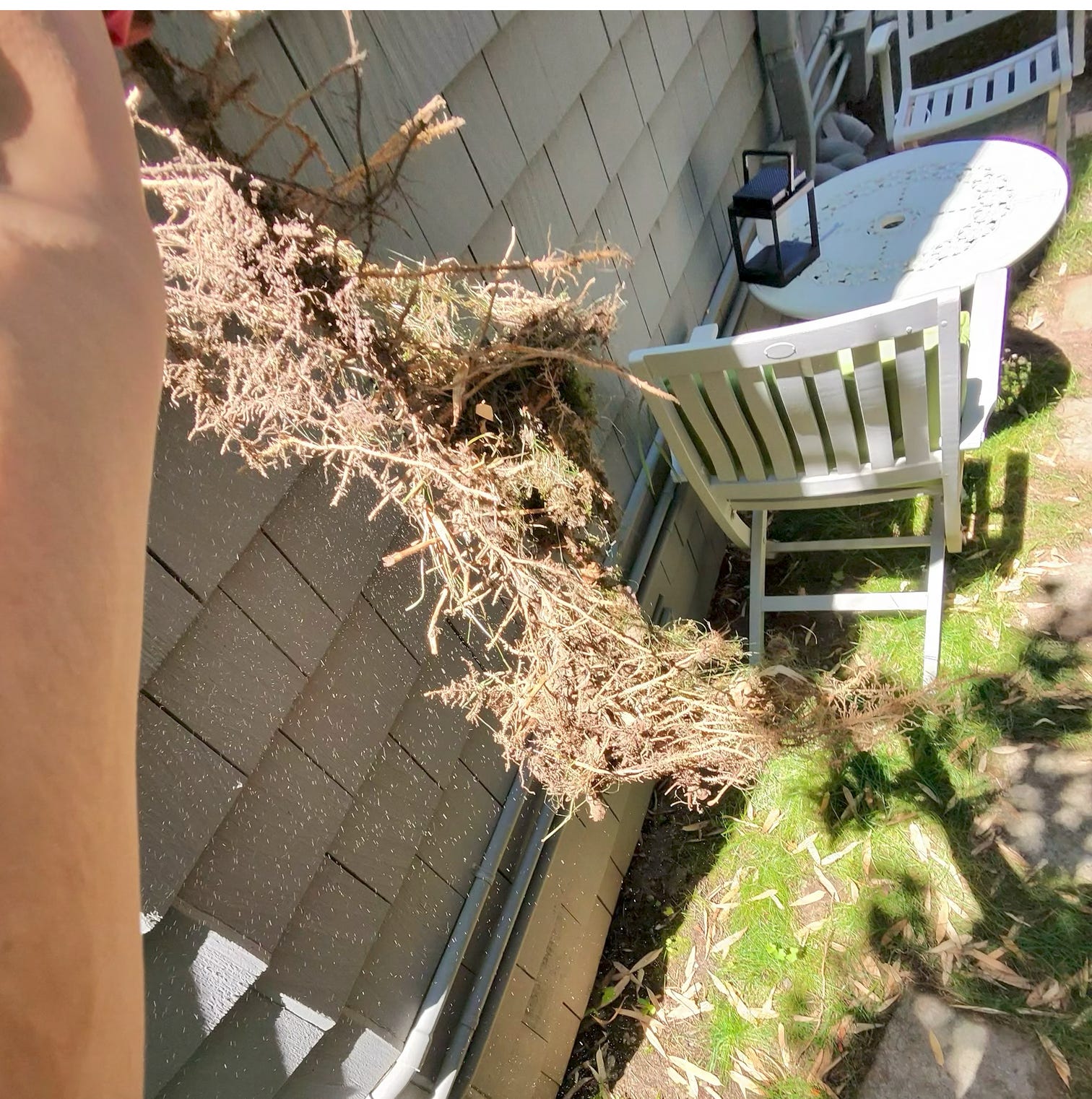
As I fought to clear these rhizomes, something shifted.
I stopped seeing them as an enemy to defeat and started seeing them as a lesson to learn. What looked like stubbornness from above ground revealed itself, once I dug deep enough, as strategy: a network built to survive exactly the kind of attack I was launching. I couldn’t help but respect that.
That same respect took root in how I thought about my father’s family. Generations back, the Gold Kims held status: royalty in name, scholars in practice, the kind of lineage that carried weight in ancient Korea through education, land, and title rather than mere birthright. They studied, they governed, they built reputations meant to outlast them.
Then history turned. Colonization stripped titles of meaning. War scattered families across borders that hadn’t existed a generation before. Communist forces rising in the North forced impossible choices. Stay and lose everything, or flee and lose almost as much. My father’s parents chose to flee. They chose to carry little more than memory and determination.
For a time, they lived unseen. Like bamboo rhizomes hidden beneath soil, they moved quietly, without the protection their ancestors once claimed. No land. No title. No guarantee of the next month, let alone the next generation. Yet they persisted, pushing through checkpoints, through starvation, through poverty, through a world that no longer recognized who they used to be.
Eventually, they found their way to the US, where survival demanded reinvention. My father built a life here that honored the scholars before him, even as he worked jobs those ancestors never imagined. He passed down more than blood. He passed down the instinct to keep growing regardless of how deep circumstances forced him to bury the roots.
I understand now why I couldn’t pull those rhizomes out like weeds. Real strength doesn’t sit on the surface, ready for anyone to grab. It runs deep, interlaced, patient. My father’s family embodied that same strength: quiet, nearly invisible at times, but impossible to uproot. Like bamboo shoots that break through soil and surprise anyone who doubted their staying power, they kept resurfacing in new countries, new careers, new generations, until they built lives in America that honored everything they carried forward.
From a bamboo root, you've woven a wonderful story. Your story is true for all of us. I tend to focus only what is visible, but life has continuously taught me that the greatest strength often grows out of sight. The power of small things that has been built in every ordinary days are enormous. I also think that sharing our thoughts and offering one another even small acts of help can become the roots that keep a community from falling apart.
A wonderful story, an honorable story, a heartwarming story. I enjoyed reading it and admire you, your father, and your grandparents. Perhaps your ancestors and my wife’s ancestors knew each other 200 or 300 years ago—though what is that, really, in the grand scheme of history? About 15 years ago, we were at a major art fair in Cologne. While looking at the work of a Korean artist, I remarked to my wife that the painter might be related to her; the artist’s surname was An, just like my wife’s. It soon became clear that they belonged to the same branch of the An family. They shared the same family history: how, 600 years ago, the family’s progenitor had come to Korea in the retinue of a Chinese princess from Taiyuan (in Shanxi province) who was traveling there to marry a king. Three hundred years later, their paths diverged; one branch remained in the capital, while the other settled near Chungju-si. Yet, within minutes, the painter and my wife were embracing, united by the awareness that they shared the same roots. We met her again a year later in Seoul. So, why shouldn't you and my children be related? It would fill me with pride and joy. Thank you for the inspiration.